
Let Capitalism Pick Up the Tab
The Greatest Discount You’ll Ever Receive Doesn’t Come From a Coupon
Most people love a good deal.
We comparison shop online before making a purchase. We wait for holiday sales. We search for coupon codes. We drive across town to save a few cents per gallon on gasoline. There is an entire industry built around helping consumers save money on the things they were already planning to buy.
And yet, when it comes to the largest expenses in life, many people completely overlook the greatest discount available to them.
The discount I’m referring to doesn’t come from a retailer. It doesn’t come from a loyalty program. It doesn’t come from a credit card reward.
It comes from ownership.
More specifically, it comes from owning small pieces of thousands of businesses through the stock market.
Over the years, I’ve noticed that many people think about investing the wrong way. They view it primarily as a retirement tool. They think of their investment account as some distant pile of money that they’ll hopefully use decades from now when they stop working.
Retirement is certainly an important goal, but it isn’t the only reason to invest.
In many ways, investing is simply a strategy for reducing the amount of your own money that you’ll need to spend on future expenses.
If you know with reasonable certainty that you will have significant expenses in the future – a wedding, a Bar Mitzvah, college tuition, retirement, helping a child purchase a home, or simply maintaining your lifestyle later in life – you have two choices.
You can pay for those expenses entirely with dollars that come from your future paychecks, or you can allow investment growth to pay for part of the bill.
The difference between those two approaches can be enormous.
Consider a simple example.
Imagine a young couple welcomes a baby boy. Like most parents, they’re excited about all of the milestones ahead. Somewhere in the distance is a Bar Mitzvah, which feels so far away that it hardly seems worth thinking about.
After all, thirteen years is a long time.
But thirteen years is also a powerful amount of time when money is allowed to grow.
If this couple were to start investing just $100 per month when their baby is born, and earning a hypothetical annual return of 9%, they will have approximately $25,794 by the time that child reaches Bar Mitzvah age.
What’s remarkable isn’t just the ending balance, but rather where that balance actually came from.
The family contributed only $15,600 over those thirteen years. The remaining $10,194 came from investment growth. In other words, nearly forty percent of the eventual account balance was generated by the businesses they owned through their investments rather than by their own labor.
Let’s consider another example that will demonstrate the magic of compound interest even more. Using the same assumptions as in the Bar Mitzvah example, a family that invests $100 per month for twenty-two years could accumulate approximately $66,548.
During those twenty-two years, the family would have contributed a total of only $26,400.
The remaining $40,148 would have come from growth. In this scenario, the market contributed substantially more than the family did. Complaining about the rising costs of Weddings might feel good when venting with friends and family, but it won’t pay the caterer bill. It is participating in the Stock Market through a disciplined and consistent approach that will pay for the extra sushi stations and 10 piece band!
Think about what that means in practical terms.
Imagine receiving a bill for $66,000.
Now imagine someone walking up and offering to pay $40,000 of it for you.
Most people would consider that the deal of a lifetime, and that is what being a long term minded investor will earn you.
The challenge, of course, is that investment growth doesn’t arrive immediately. Human beings naturally prefer instant gratification. We like immediate results. We like certainty. We like seeing progress right away.
The stock market asks us to embrace the opposite approach.
It asks us to be patient.
It asks us to delay gratification.
It asks us to trust that productive businesses will continue creating value over long periods of time.
Historically, that has been a very good bet.
When you purchase a broadly diversified portfolio of stocks, you’re buying ownership in companies that manufacture products, provide services, develop technology, transport goods, build infrastructure, and solve problems. Every day these businesses wake up trying to become more profitable than they were yesterday.
As shareholders, we participate in that growth.
This is one of the reasons I often tell clients that investing is not merely a savings strategy. It is a partnership strategy. Yes, your paycheck, savings rate, and discipline all matter, but eventually there comes a point where your money begins working alongside you.
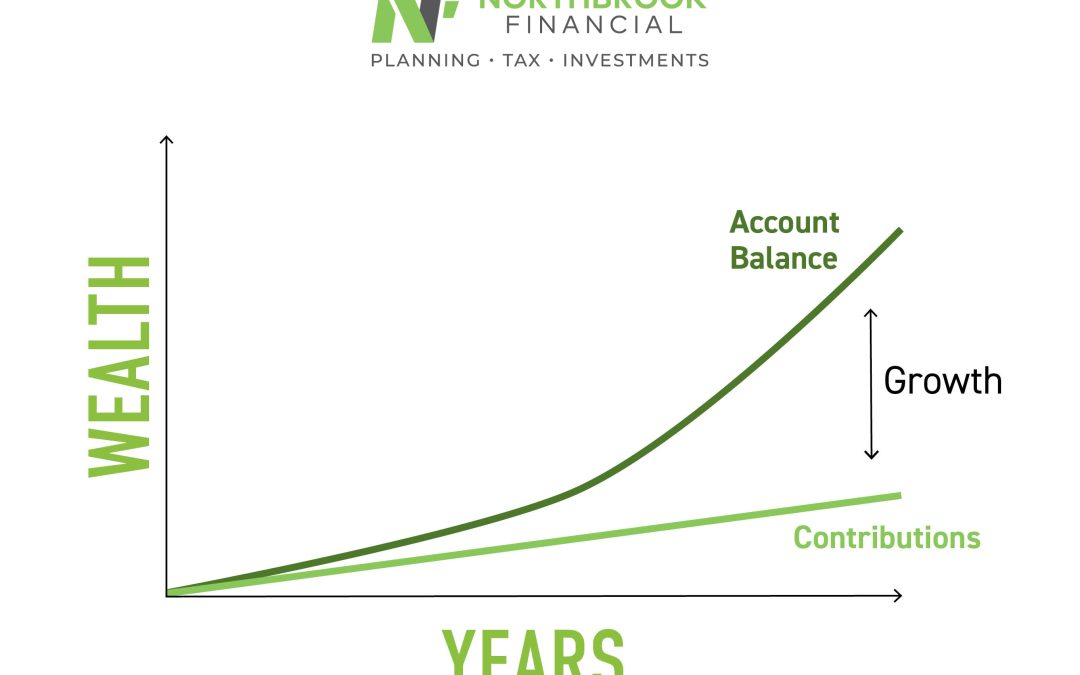
At first, your contributions are doing most of the work. Over time, however, investment growth begins carrying a larger share of the load. Eventually, the growth itself can exceed the amount you contributed.
That is the moment when the true power of compounding becomes visible.
Warren Buffett famously accumulated the vast majority of his wealth after age sixty. Not because he suddenly became a better investor compared to his younger years, but because compounding had finally been given enough time to work its magic.
The same principle applies to ordinary families. While the majority of people won’t become billionaires, many people can dramatically reduce the amount of their own earnings required to fund future goals. The primary benefits of wealth aren’ necessarily having the largest house or the most expensive car. The value of real wealth is having assets that help carry the financial burden of your future.
Every dollar that comes from investment growth is a dollar that doesn’t need to come from your paycheck, and when viewed through that lens, investing becomes much more exciting.
At Northbrook, we often encourage clients to think of investing as putting capitalism to work on their behalf. Every month that you consistently invest, you are hiring thousands of businesses around the world to help fund your future goals.
Some years will be better than others. Markets will experience downturns. Volatility is part of the process. But history has repeatedly demonstrated that disciplined investors who remain patient are often rewarded for giving their money sufficient time to grow.
The next time you think about a future expense, whether it’s a Bar Mitzvah, a wedding, retirement, or another major financial goal, ask yourself a simple question:
Do I want to pay for this entirely myself?
Or would I rather let capitalism pick up part of the tab?
For those who start early and stay disciplined, the answer can be worth tens of thousands of dollars or even more!
The information contained herein is intended to be used for educational purposes only and is not exhaustive. Diversification and/or any strategy that may be discussed does not guarantee against investment losses but are intended to help manage risk and return. If applicable, historical discussions and/or opinions are not predictive of future events. The content is presented in good faith and has been drawn from sources believed to be reliable. The content is not intended to be legal, tax or financial advice. Please consult a legal, tax or financial professional for information specific to your individual situation.
This content not reviewed by FINRA